.png)















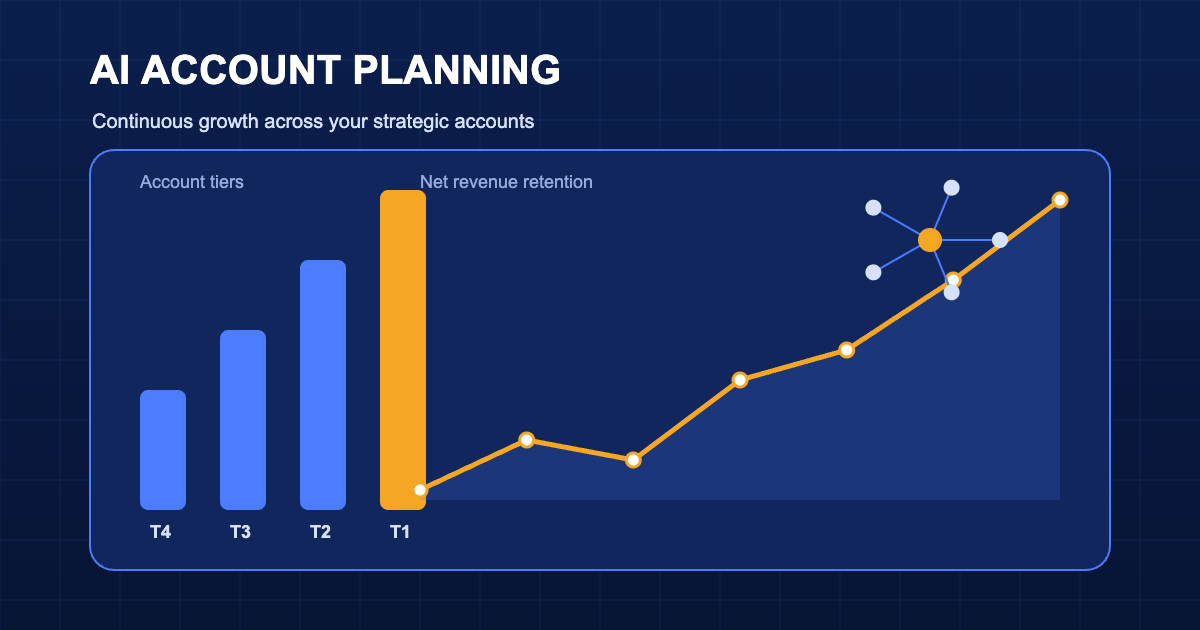
Last updated: June 15, 2026
The biggest accounts in your book rarely churn or expand because of what happens in a single meeting. They drift. A champion changes roles, a competitor sneaks into one business unit, a renewal creeps up while three open expansion opportunities sit untouched. By the time a quarterly review surfaces the problem, the window to act has usually closed.
Account planning is the discipline built to prevent that drift — and AI is the first thing that has made it work continuously instead of once a quarter. This guide breaks down what AI account planning actually is, why it has become the center of gravity for B2B growth, and a practical playbook for putting it to work across your sales and post-sales teams.
What is AI account planning?
Account planning is the process of mapping a strategic account — its org chart, goals, risks, relationships, and untapped opportunities — and turning that map into a prioritized set of actions to retain and grow it. Traditionally it lived in a slide deck that a rep updated the night before a review and forgot about until the next one.
AI account planning replaces that static artifact with a continuously updated model. It pulls signals from your CRM, product usage, support tickets, emails, and call recordings, then keeps the plan current on its own: scoring relationship health, flagging at-risk stakeholders, surfacing whitespace, and recommending the next best action. Vendors across the category now generate first-draft account plans automatically and refresh them as new data arrives, rather than asking a human to assemble everything by hand (Copy.ai).
How it differs from account-based marketing
It is easy to confuse the two. Account-based marketing is about acquiring and engaging target accounts at the top of the funnel. Account planning is about retaining and expanding the accounts you have already won. They are complementary — if you are running AI account-based marketing to land tier-1 logos, account planning is what keeps those logos growing for years afterward.
Why account planning is where B2B growth now lives
For most B2B companies, the math of growth has quietly inverted. Existing customers now generate roughly 40% of new ARR overall, and expansion alone accounts for about 35% of new ARR — a meaningful shift toward growing the base rather than only chasing net-new logos (Pavilion 2025 B2B SaaS benchmarks). When a third or more of your growth comes from accounts you already own, how deliberately you plan those accounts becomes a primary revenue lever, not an administrative chore.
The retention data tells the same story. Best-in-class net revenue retention runs above 130%, while the 2025 median has compressed to roughly 101% (Pavilion). The gap between a 101% and a 130%-plus company is almost entirely a function of how systematically they protect and expand strategic accounts.
The problem is capacity. Sellers spend roughly 70% of their time on non-selling work — admin, data entry, and internal meetings — leaving little room for the deep, proactive planning that key accounts require (Salesforce State of Sales research). Manual account planning is the first thing to get dropped when a quarter gets busy. AI closes that gap by doing the assembly and monitoring work that humans never had time for.
How AI builds a living account plan
A modern AI account plan is assembled from four continuously refreshed layers. Each maps to a question every account owner should be able to answer at any moment — not just before a review.
| Layer | Question it answers | Signals AI uses |
|---|---|---|
| Relationship map | Who holds power, and where are we blind? | Email/meeting activity, title changes, single-threading alerts |
| Health | Is this account safe or slipping? | Product usage, support sentiment, engagement trend |
| Whitespace | Where can this account grow? | Unadopted products, peer benchmarks, hiring/intent signals |
| Next best action | What should the owner do this week? | Prioritized plays ranked by revenue impact and urgency |
Relationship mapping and risk
AI watches who is actually engaging inside an account and warns you when coverage thins — for example when every active thread runs through one stakeholder. That single-threading risk is exactly what disciplined deal teams attack with mutual action plans, and the same logic applies to protecting an installed account.
Health and whitespace
The health layer borrows directly from AI customer health scoring, which can flag churn risk well before it shows up in usage dashboards. Whitespace detection then layers on expansion potential, often using the same buyer intent signals that surface new-business pipeline — applied instead to growth inside accounts you already own.
This is where an AI worker earns its keep. Darwin AI's post-sales agent, Sophia, can monitor these signals across your entire book continuously, keep each account plan current, and nudge owners the moment a health score dips or a whitespace opportunity opens — the proactive monitoring no human team has the hours to do manually.
A five-step playbook to operationalize it
Tooling alone does not create discipline. Use this sequence to turn AI account planning into a repeatable motion:
- Tier your accounts. Reserve full planning for the 20–30 accounts that drive the majority of expansion potential. Everything else runs on lighter automation.
- Auto-generate the first draft. Let AI assemble the relationship map, health score, and whitespace for each tier-1 account so owners start from data, not a blank slide.
- Set the cadence. Replace the once-a-quarter scramble with a continuously updated plan, reviewed in a lightweight weekly check and a deeper monthly session. Your QBR motion becomes a confirmation of work already in flight, not a fire drill.
- Assign next best actions. Convert AI recommendations into owned tasks with deadlines. A plan no one executes is just a prettier report.
- Tie it to onboarding. The strongest expansion accounts are the ones that reached value fast, so connect plans to your customer onboarding motion from day one.
Metrics that prove it is working
Account planning earns its place when the numbers move. Track net revenue retention as the headline outcome, then watch leading indicators: multi-threading depth (stakeholders engaged per account), expansion pipeline created from existing accounts, and time-to-action on health alerts. Teams that plan their key accounts systematically tend to attribute an outsized share of their growth to those account-based motions (Salesmotion). If your retention is sitting near the median and your expansion pipeline is thin, account planning is usually the highest-leverage fix available.
Pair these with your forecasting discipline. The same rigor that powers AI sales forecasting on new business should govern your expansion pipeline, so renewals and upsells are predicted with the same confidence as net-new deals.
Stop planning your accounts once a quarter
Darwin AI keeps every strategic account plan current, flags risk and whitespace in real time, and tells your team exactly what to do next — so expansion stops slipping through the cracks.
See how Sophia grows your accounts →Frequently asked questions
What is the difference between account planning and a CRM?
A CRM stores account data; account planning interprets it. AI account planning sits on top of your CRM and turns raw records into a prioritized, continuously updated growth strategy for each strategic account.
How many accounts should we actively plan?
Focus deep planning on the 20–30 accounts (or top tier) that drive most of your expansion potential. AI can monitor the long tail automatically and escalate only when a signal warrants attention.
Does AI account planning replace customer success managers?
No. It removes the manual assembly and monitoring work so CSMs and account managers spend their time on relationships and strategy — the parts of the job that actually move retention.
How is this different from customer health scoring?
Health scoring is one input. Account planning combines health with relationship mapping, whitespace, and next-best-action recommendations into a complete plan to retain and grow the account.